


What It Costs to Charge an Electric Car in Australia
Charging an electric car usually costs a lot less than filling a tank, and the maths is simpler than you might think. At an Evie fast charger, a typical top-up from 20% to 80% costs around $16 to $28 for a smaller EV and around $31 to $46 for a long-range EV. Charging at home is usually cheaper again per kWh, while public fast charging wins on speed when you are out and about.
Here is how the numbers work, what changes the price, and how to check exactly what you will pay before you plug in.
Quick answers
- Cost to charge = price per kWh x kWh delivered to your car.
- Evie prices vary by charger speed, and every price is shown in the Evie app before you start.
- Driving 100 km in a typical EV costs around $12 on a public fast charger, versus around $17 in fuel for a petrol car.
- Charge to 80% to save time, and choose the charger speed your car can actually use to save money.
How to Work Out the Cost of Charging an Electric Car
Petrol is sold by the litre. Electricity is sold by the kilowatt-hour (kWh), which is simply a unit of energy. Your EV’s battery size is measured in kWh too, so working out a charging cost takes one quick sum:
Price per kWh x kWh added = cost of your charge
For example, if your EV has a 60 kWh battery and you charge from 20% to 80%, you add about 36 kWh (60% of 60 kWh). At an example rate of 68c per kWh, that charge costs about $24.50.
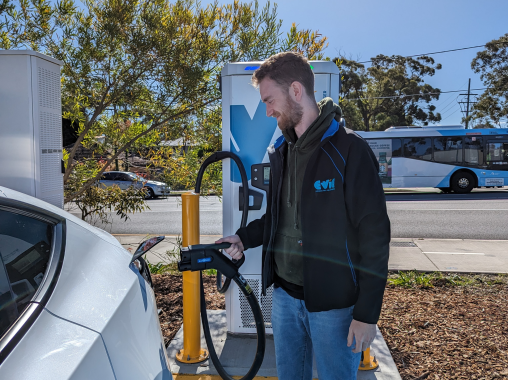
How Much Does It Cost to Charge at an Evie Fast Charger?
Evie charges by the kWh, so you only pay for the energy that goes into your car. Prices vary from station to station and by plug type, because charging speeds and energy prices differ in each state and territory. To check the price at any site, tap the station in the Evie app to see the price for each connector, or check the Find a Charger page. For more on how Evie prices work, see our charging cost FAQ.
Here is what a 20% to 80% top-up looks like for some of Australia’s most popular EVs, at an example rate of 60c per kWh:
| EV model | Battery size (approx.) | Energy added, 20% to 80% | Cost at 68c per kWh |
| Geely EX2 Complete | 35 kWh | 21 kWh | About $14 |
| BYD Atto 3 Extended Range | 60.5 kWh | 36 kWh | About $25 |
| Tesla Model Y RWD | 60 kWh | 36 kWh | About $24 |
| Geely EX5 | 60 kWh | 36 kWh | About $24 |
| MG4 Excite 64 | 64 kWh | 38 kWh | About $26 |
| Zeekr 7X Standard RWD | 75 kWh | 45 kWh | About $31 |
| Kia EV6 (long range) | 84 kWh | 50 kWh | About $34 |
Examples only. Your actual price depends on the station, connector and how much energy your car takes. Always check the Evie app for live pricing.
Driving something else? Our brand guides cover BYD, Tesla, Kia, Hyundai, MG, Polestar, Zeekr and Geely.
How Much Does It Cost to Charge a Tesla?
Tesla drivers can charge at Evie too. Most Teslas sold in Australia plug straight into Evie’s CCS2 fast chargers, while some older Model S and Model X vehicles (pre-2020) may need a CCS2 adapter.
- Model 3 or Model Y RWD (around 60 kWh): a 20% to 80% charge adds about 36 kWh, which is about $24.50 at 68c per kWh.
- Long Range models (around 75 to 80 kWh): a 20% to 80% charge adds about 45 to 48 kWh, which is about $31 to $33 at 68c per kWh.
Prices at Evie are the same for every make of car, so there are no Tesla-specific rates. See our Tesla charging guide for compatibility and charge times.
Home Charging vs Public Fast Charging: Which Costs Less?
Home charging usually costs less per kWh, but it is slow and not everyone has a driveway or garage. Public fast charging costs more per kWh, but it adds hundreds of kilometres in the time it takes to grab a coffee. Most EV drivers use a mix of both.
| Home (standard rate) | Home (off-peak or EV plan) | Public fast charger | |
| Typical price per kWh | Around 27c to 42c | Around 8c to 22c, or free during set midday hours on some plans | Around 45c to 80c |
| Time to add 300 km | Overnight on a wall charger | Overnight on a wall charger, or during free midday hours | Around 20 to 60 minutes, depending on charger and car |
| Best for | Daily driving if you have off-street parking | Cheapest top-ups if you can charge at the right times | Road trips, quick top-ups, apartment living |
Home prices vary by state, retailer and plan. Check your electricity bill for your own rate.
EV vs Petrol: What Does 100 km Cost?
A typical EV uses around 16 kWh to travel 100 km. Here is how that compares with a petrol car using 8 litres per 100 km at around $2.30 a litre:
- Public fast charging at 68c per kWh: about $11 per 100 km
- Home charging at 31c per kWh: about $5 per 100 km
- Off-peak home charging at 18c per kWh: about $3 per 100 km
- Petrol at around $2.30 a litre (November 2026): about $19 per 100 km
So even when you charge on the road, you are likely to spend less per kilometre than you would at the bowser.
1. Download the Evie Charging App and create an account
Remember to add a payment method to complete your account set-up.
2. Plug in your car using the correct plug type (CCS2 or CHAdeMo)
3. Select the charging station you’re at
If you have location services enabled, the Evie App will prompt you with a message about the station you’re currently at. Otherwise, tap ‘Scan’ on the map screen and direct the camera to the QR code on the charger you’d like to use.
4. Select your plug and tap the “Start Charging” button in the Evie app
Now you’re good to go! Make sure you enable notifications in your Profile Settings to stay updated about your charging progress.
5. To stop the charge, press “Stop Charge” button located near the charger screen, or tap stop charge in the Evie app.
Have a charging voucher you’d like to use? Follow these steps here to select your charging voucher as your main payment method.
Keep in mind, every Evie location offers different charge speeds, and the speed you charge at can vary. Find out more about charge speeds here.

What Affects the Price of a Charge?
- The station and connector: each site can price its connectors differently, so a 50 kW plug may cost less than a 350 kW plug at the same site.
- Where you are: energy prices differ between states and territories.
- Your battery size: a bigger battery holds more kWh, so a full charge costs more (and takes you further).
- How full your battery is: charging from 20% to 80% costs less than 0% to 100%, and charging slows down above 80%.
- Temperature and battery condition: these affect how fast your car charges, not the price per kWh. Learn more about what determines charge speed.
- How you pay: paying with the Evie app gives you access to app pricing and offers.
How to Check the Price Before You Charge
- Open the Evie app or the Find a Charger page.
- Tap a station to see live availability, connector types, charging speeds and the price for each connector.
- Filter by maximum power to show only the chargers that suit your car.
- Plug in and start charging. With Autocharge set up, your session starts as soon as you connect.
- Track your session in the app and see the cost of every charge in your history.
New to public charging? Our how to charge guide walks you through your first session.

Easy Ways to Save on Public Charging
- Stop at 80%: charging slows down above 80%, so you spend longer plugged in for less range.
- Match the charger to your car: if your EV peaks at 100 kW, a 350 kW plug will not charge it any faster. Check the price of each connector in the app and pick the one that suits.
- Check for offers: see the latest Evie charging offers, including the RACQ membership offer.
- Plan your stops: use the app to find stations along your route before a road trip, so you charge where it suits you, not where you have to.

Your EV Charging Cost Questions, Answered
How much does it cost to charge an electric car in Australia?
It depends on where you charge and the size of your battery. At an Evie fast charger, a 20% to 80% charge typically costs around $16 to $28 for a smaller EV and $31 to $46 for a long-range EV. Charging at home usually costs less per kWh, especially on an off-peak or EV electricity plan.
How much does a full charge cost?
Multiply your battery size by the price per kWh. For example, a 60 kWh battery charged from empty to full at 60c per kWh costs about $36. Most drivers rarely charge from 0% to 100%, so a typical session costs less.
Is it cheaper to charge an EV at home?
Usually, yes. Home electricity is often around 27c to 42c per kWh on a standard rate and less on off-peak plans, compared with around 45c to 75c at public fast chargers. Public charging is faster, though, and it is the go-to for road trips and drivers without off-street parking.
Do Evie chargers charge by the minute or by the kWh?
By the kWh. You pay for the energy that goes into your car, and the price for each connector is shown in the Evie app before you start.
Do I need a membership to charge with Evie?
No membership needed. You just need a free Evie account, which takes a few minutes to set up in the Evie app. A small number of sites also offer Tap & Go with a credit or debit card.
Why do prices differ between Evie stations?
Charging speeds and energy prices differ by location, state and site, so each station can have its own price. The app always shows the price before you plug in, so there are no surprises.
Know the Price Before You Plug In
Download the Evie app to see live prices, find a free charger near you and start charging in a tap. Fast, simple and upfront.